If you have spent any time admiring Holland Lops online, you have almost certainly stopped scrolling at a BEW rabbit, a pure snow-white bunny with deep sapphire eyes that look almost too blue to be real. BEW stands for Blue-Eyed White, and it is one of the most striking color varieties in the whole rabbit world. Here is what actually makes a BEW rabbit tick, from the genetics behind those eyes to what daily care really looks like.

CAPTION: The signature look of a BEW: a solid white coat paired with deep blue eyes.
What a BEW rabbit actually is
Here is the first thing worth clearing up: BEW is a color, not a breed. You can find Blue-Eyed Whites in Holland Lops, Netherland Dwarfs, Mini Lops, and many other breeds. So a BEW rabbit is any bunny carrying the genetics for a solid white coat paired with blue eyes. The breed tells you the body type and size. The Blue-Eyed White part tells you the color story riding on top of it.
The Vienna gene and those blue eyes
Those famous eyes come from the Vienna gene. It is recessive, which means a rabbit needs two copies of it, written as vv, to be a true BEW. When both parents pass along a copy, you get the solid white coat and the clear blue eyes together.
A rabbit with only one copy, written Vv, is a different story. These are called Vienna carriers or Vienna marked rabbits, and they can show up in a few ways: blue eyes with a colored coat, random white patches, a blue spot or two, or sometimes no visible sign at all. That last possibility is exactly why breeders track Vienna genetics so carefully. A hidden carrier can surprise you generations later.
A BEW is not the same as a REW
People mix these two up constantly, so let me untangle them. A REW, or Ruby-Eyed White, is an albino rabbit. Its white coat comes from the albino gene, and its eyes glow pink or red because they lack pigment entirely. A BEW rabbit reaches white through the Vienna gene instead, and it keeps pigment in the eyes, which is why they read as blue. Two very different genetic roads that happen to end at a white bunny.
BEW in Holland Lops
In the Holland Lop specifically, a well-bred BEW is a real showpiece. You want all the things that make a Holland lovely, the compact body, the short crown, the sweet lopped ears, and then that clean white coat and those blue eyes on top. Getting good type and good Vienna color in the same rabbit takes intention, which is why serious breeders plan these pairings rather than leaving them to chance.
Are BEW rabbits healthy? The hearing question
This one deserves an honest answer. In some blue-eyed white cats and dogs, the same pigment genetics are firmly linked to deafness. In rabbits that link is far less established, and most BEW rabbits hear perfectly well and live long, ordinary, happy lives. Even so, careful breeders keep an eye on it. In my own program I include BAER testing, a quick and painless hearing check, because I would rather know than guess. When you buy a BEW rabbit, it is fair to ask the breeder how they approach hearing and overall health. For general wellness guidance, the House Rabbit Society and a trusted vet resource like VCA Animal Hospitals are both worth a read.
Caring for a BEW rabbit
Day to day, a Blue-Eyed White needs the same things as any other Holland Lop: unlimited hay, a measured amount of quality pellets, fresh greens, clean water, and plenty of gentle handling. The one small extra is that white fur shows every stain, so a tidy living space keeps that snowy coat looking its best. Beyond that, care is refreshingly normal.
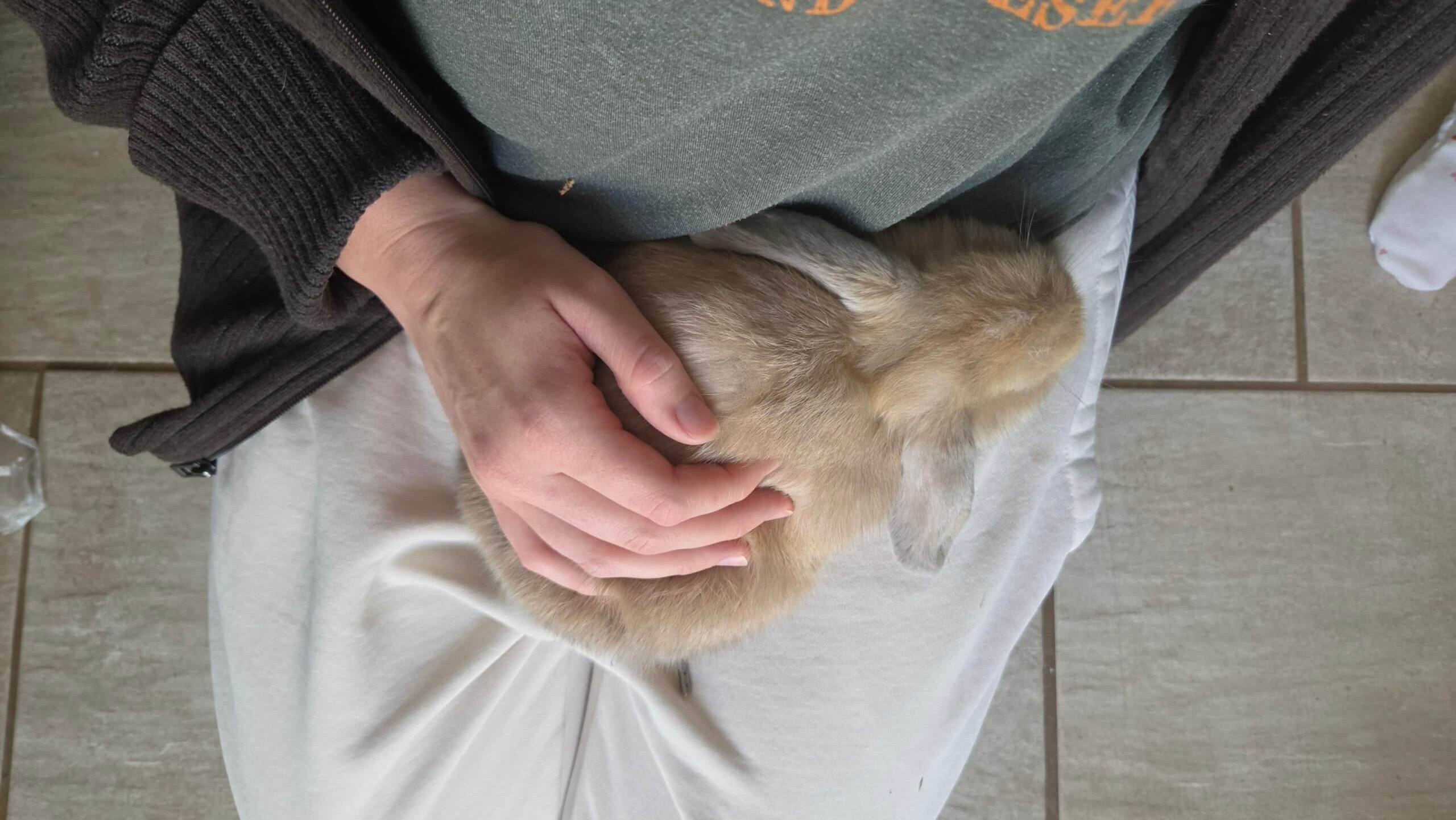
Caption: a BEW rabbit next to a non-vienna (no blue eyes) rabbit.
Why breeders and buyers adore them
There is just something about a BEW rabbit. The contrast of white and blue photographs beautifully, the color is uncommon enough to feel special, and the genetics behind it reward a breeder who plans thoughtfully. For buyers, a Blue-Eyed White is a little piece of living art that also happens to be a wonderful companion.
Meet our Blue-Eyed Whites
Blue-Eyed White genetics sit at the heart of the Rhythm & Bleu program. If you would like to see our BEW rabbits and the lines behind them, visit:
and when you are ready to bring your new family member home: